
Shopping Cart
There are no more items in your cart
- Our blog
- 0 likes
- 332 views
- 0 comments
A Guide to Gin Styles: Gin, London Dry, Old Tom and More
Gin, Distilled Gin, London Dry, Old Tom… When looking at a bottle of gin, you may come across many different terms, and it is not always obvious what each one means. Some refer to the production method, others to sweetness levels, while others describe historical or commercial styles. But they all share one essential ingredient: juniper.
In this guide, we explain the main differences so you can understand gin labels better and choose the style that best suits each occasion.
What is gin?
Gin is a spirit made from ethyl alcohol of agricultural origin and flavoured with juniper berries. Under European Union rules, juniper must be the predominant flavour and the minimum alcoholic strength is 37.5% ABV.
A wide range of botanicals can be used alongside juniper, including coriander seed, angelica root, lemon or orange peel, cardamom, liquorice, pepper, flowers, herbs and spices.
The combination of these ingredients is what makes gin such a diverse category, ranging from classic, dry and juniper-led styles to distinctly citrus, floral, herbal or spicy gins.
What does Dry Gin mean?
The word dry refers to a lack of sweetness, but when used for gin it also has a technical meaning.
Under European rules, a gin may use the term dry when it contains no more than 0.1 grams of sweetening products per litre of the final product, expressed as invert sugar.
Dry Gin therefore does not, by itself, define a particular distillation method. Above all, it tells us that the gin contains virtually no added sugar.
Gin, Distilled Gin and London Gin: what is the difference?
Gin
Gin is the broadest category. Agricultural-origin alcohol is flavoured with juniper and may include other flavourings. Not all of those flavours have to come from a new distillation, but juniper must remain the predominant flavour.
Distilled Gin
With Distilled Gin, an essential part of the production process involves redistilling agricultural-origin alcohol in the presence of juniper berries and other natural botanicals.
After distillation, certain flavourings or flavouring preparations may be added within the limits allowed for this category. A product made simply by adding essences or flavourings to alcohol cannot be labelled Distilled Gin.
London Gin or London Dry Gin
London Gin is a much more tightly defined type of Distilled Gin. Despite the name, it does not have to be made in London.
In this style, the flavours must come from distilling the alcohol together with natural plant materials. No additional flavouring ingredients may be added afterwards, and the gin cannot contain colourings. Sweetening is also restricted to a maximum of 0.1 g per litre.
The term London Gin may be supplemented by the word Dry, which is why London Dry Gin is such a common expression on labels.
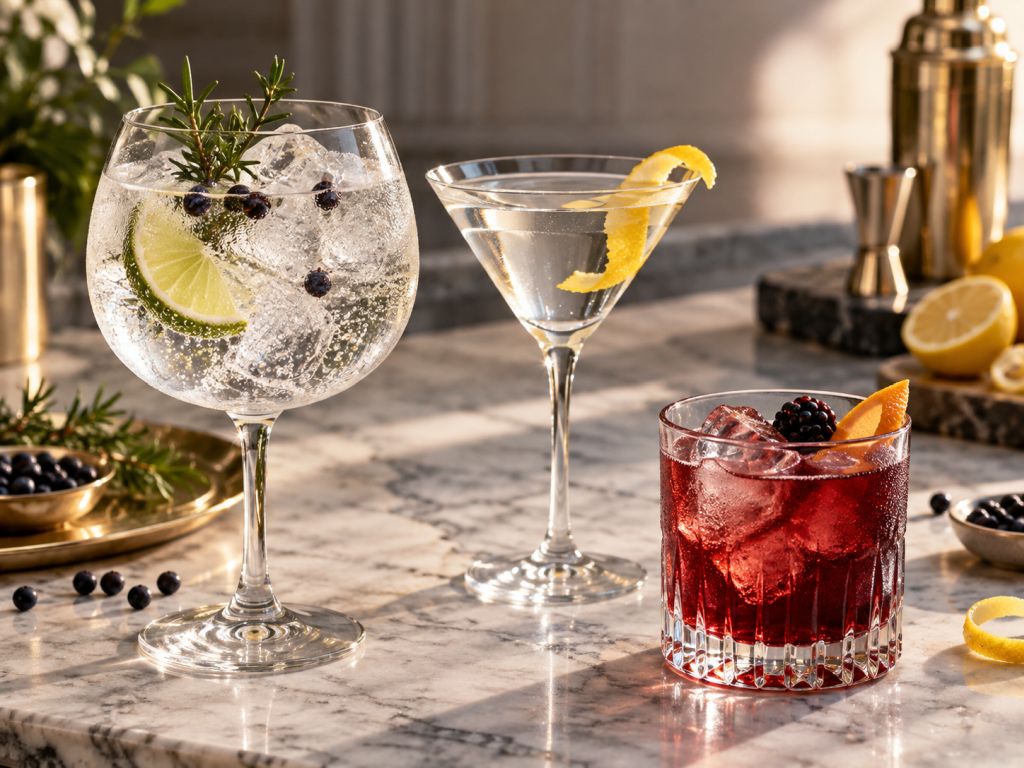
It is one of the classic reference styles for cocktails such as the Dry Martini, Negroni and Gin & Tonic.
Other gin styles and related drinks
Old Tom Gin
Old Tom is a historic gin style that is traditionally a little sweeter and rounder than London Dry. It was particularly popular during the 18th and 19th centuries and has enjoyed a revival with the return of classic cocktail culture.
Its profile usually sits between the dryness of London Dry and sweeter styles, although Old Tom is not currently a distinct EU legal category with one fixed recipe. It is especially associated with classic cocktails such as the Tom Collins.
Sloe Gin
Despite its name, Sloe Gin is not technically gin but a liqueur. It is made by macerating sloe berries in gin and may also include sloe juice.
The result is a sweeter, fruitier drink with a lower alcoholic strength than conventional gin. In the European Union, it must have a minimum alcoholic strength of 25% ABV.
Navy Strength Gin
Navy Strength is a traditional term used for particularly high-strength gins, commonly around 57% ABV.
It is not a specific legal category under EU gin rules, but rather a style designation. Its higher strength delivers considerable aromatic intensity and can work especially well in cocktails where the character of the gin needs to remain pronounced after dilution with ice and other ingredients.
Genever or Jenever
Genever, or Jenever, is historically linked to the origins of modern gin, but it should not simply be treated as another modern gin style.
Originating mainly in the Netherlands and Belgium, traditional Genever may include a grain-based distillate known as malt wine. This can give it a more malty, cereal-driven and complex character than classic gin, sometimes bringing it aromatically closer to grain spirits.
It is one of the key historical predecessors of the gin we know today.
What about citrus, floral or fruit-forward gins?
These descriptions are more about aromatic profile than legal category. A gin may be made with citrus fruit, flowers, herbs or spices and still qualify as gin, provided it meets the relevant category requirements and juniper remains the predominant flavour.
This is why gins are often commercially described as citrus, floral, herbal or spicy. These terms mainly help us anticipate their aromatic style.
Examples from our selection
To make the differences easier to see in practice, here are some examples from our own selection, grouped by style and aromatic profile:
· London Dry Gin: Beefeater, Tanqueray, Bombay Sapphire, Bombay Original, Bulldog, Sipsmith, Master's, Cubical, Oxley, Whitley Neill, Bloom, Mombasa Club, The Botanical's and Larios Dry.
· Dry Gin and Distilled Gin: Monkey 47, Blue Gin, Aviation, Citadelle, Martin Miller's and Seagram's Extra Dry.
· Contemporary and aromatic gins: Gin Mare, Nordés, Hendrick's, Roku, G'Vine Floraison, Caorunn, Larios 12, Giro, IBZ Gin and Brockmans.
· Flavoured gins: Puerto de Indias Strawberry, Puerto de Indias Sweet Melon, Malfy Gin con Limone and 1890 Exótica.
· Old Tom Gin: Hayman's Old Tom, a useful reference point for understanding this historic style.
· Sloe Gin and gin liqueurs: Hayman's Sloe Gin, Gordon's Sloe Gin and Hayman's 1820. These are sweeter drinks and are best distinguished clearly from dry gin.
· Alcohol-free: Tanqueray 0.0 and Seagram's 0.0, botanical alternatives for those looking for a non-alcoholic option.
A special mention goes to Xoriguer: it is Gin de Mahón, protected by its Geographical Indication and with a distinctive identity of its own within the gin category.
How to choose a gin for different cocktails
For a Gin & Tonic
London Dry is a classic choice when you want a dry, defined Gin & Tonic with clear juniper character. Citrus, Mediterranean, floral or spicy gins can also work very well depending on the tonic and the overall profile you want to achieve.
The key is not to overload the glass: a good gin and a good tonic rarely need much else.
For a Dry Martini
Dry, structured gins work particularly well, especially London Dry styles, because they retain the character of juniper and botanicals alongside the vermouth.
For a Negroni
Choose a gin with enough structure and aromatic intensity to balance the sweet vermouth and bitter component. Classic London Dry styles are often an excellent fit.
For a Tom Collins
Traditionally, the Tom Collins may be made with Old Tom Gin, whose subtle sweetness works very well with lemon and soda. London Dry can also be used for a drier result.
In short: Gin, Dry Gin, Distilled Gin and London Dry
A simple way to remember the differences is:
· Gin → the general category: agricultural-origin alcohol flavoured with juniper, which must remain the predominant flavour.
· Dry Gin → gin with virtually no added sugar.
· Distilled Gin → gin whose production includes redistillation with juniper and other botanicals.
· London Dry Gin → a type of Distilled Gin made under particularly strict rules: its flavours come from distillation, it contains no colourings and it permits virtually no sweetening.
Alongside these, you will also find historic styles such as Old Tom, style terms such as Navy Strength, modern aromatic profiles and related drinks such as Genever and Sloe Gin.
Understanding these differences is useful not only for reading a label, but also for choosing the right gin for your taste and for the way you plan to serve it.
Comments (0)