
Shopping Cart
There are no more items in your cart
- Our blog
- 0 likes
- 439 views
- 0 comments
What is Tokaj?
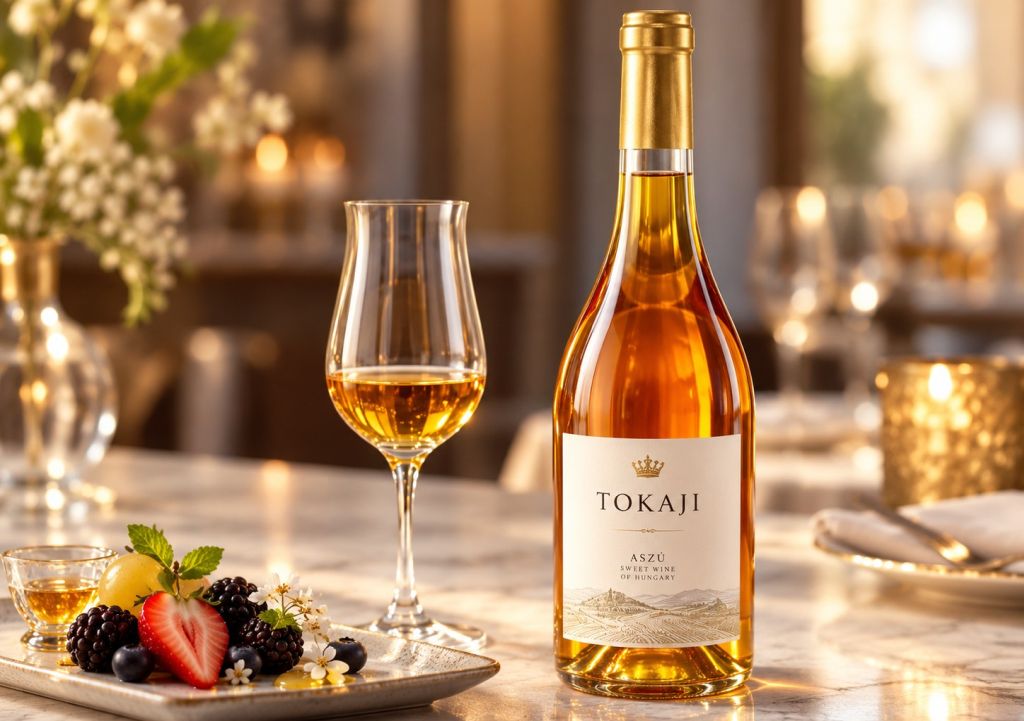
Tokaj is a historic wine-growing region in north-eastern Hungary, internationally renowned for its white wines and, above all, for its great botrytised sweet wines. The protected designation in the European Union is the Tokaj / Tokaji PDO.
The distinctive character of Tokaj’s sweet wines is based on the action of Botrytis cinerea, commonly known as noble rot. Under specific conditions of humidity, fog, dry and sunny days, and good ventilation, the fungus partially dehydrates the grape berries, concentrating sugars, acids and aromatic compounds without causing undesirable rot.
Main grape varieties
· Furmint: Tokaj’s key grape variety. Its high acidity helps balance wines with a very high sugar concentration. It is also used to produce outstanding dry white wines.
· Hárslevelű: Adds softness, texture and floral notes.
· Sárga Muskotály (Yellow Muscat): Highly aromatic, contributing perfume and expressiveness.
· Zéta and Kövérszőlő: Authorised varieties that can contribute fruit, richness and concentration.
The main wine styles of Tokaj
Dry white: White wines, frequently dominated by Furmint. They show acidity, minerality and ageing potential.
Late Harvest: A late-harvest style. A more direct and accessible sweet wine, made from overripe and/or botrytised grapes depending on the producer.
Szamorodni: Made from whole bunches containing a natural mixture of healthy, overripe and botrytised berries. It can be dry or sweet.
Aszú: The great classic sweet wine of Tokaj. It is produced using hand-selected noble Aszú berries, which are macerated with must, fermenting must or base wine.
Eszencia: An extremely concentrated must that runs freely from the Aszú berries under their own weight. It has an exceptionally high sugar concentration and very low alcohol due to the difficulty of fermentation.
At Celler del Cava, we offer a wide selection of wines from Tokaj.
What does “puttonyos” mean?
The puttony was originally a harvest container or basket used to carry and measure Aszú berries. The traditional system linked the number of puttonyos of noble berries added to a fixed quantity of base wine or must, historically associated with the Gönc cask of approximately 136 litres.
Over time, the number of puttonyos came to express mainly a level of concentration and sweetness. The best-known historical scale was as follows:
| Historical indication |
Traditional minimum residual sugar |
Interpretation |
| 3 puttonyos |
60 g/l |
Sweet; lower historical level |
| 4 puttonyos |
90 g/l |
Greater concentration |
| 5 puttonyos |
120 g/l |
Concentrated Aszú; benchmark for the modern system |
| 6 puttonyos |
150 g/l |
Highest classic indication of concentration |
The 2013 change and how it should be understood today
Since the reform applied to wines from the 2013 vintage onwards, any wine marketed as Tokaji Aszú must contain at least 120 g/l of residual sugar. Therefore, a modern Aszú can no longer exist with the historical analytical concentration of 3 puttonyos (60 g/l) or 4 puttonyos (90 g/l).
However, this does not mean that the terms “3 puttonyos” and “4 puttonyos” have legally disappeared from labelling. The current rules still authorise the indications Aszú 3, 4, 5 and 6 puttonyos. An Aszú produced under the modern system must still meet the general minimum of 120 g/l even if 3 or 4 puttonyos appears on the label. The indication 6 puttonyos may only be used when the wine reaches at least 150 g/l of residual sugar.
For this reason, the 60–90–120–150 g/l table should be understood as the historical reference scale, not as four current analytical production levels.
Current European regulations: 2026 amendment
The most recent amendment to the product specification of the Tokaj / Tokaji PDO was approved by Commission Implementing Regulation (EU) 2026/1556 of 2 July 2026, published in the Official Journal of the European Union on 6 July 2026. The Regulation approves a Union amendment to the product specification of the Tokaj / Tokaji PDO and is currently in force.
The amendment application published by the European Union clarifies, among other matters, wine categories, certain analytical parameters, ageing periods, production rules, and presentation and labelling requirements.
Key points of particular relevance
· Aszú retains a general minimum of 120 g/l of residual sugar.
· The authorised traditional indications for Aszú include “Aszú 3, 4, 5 or 6 puttonyos”.
· The indication “6 puttonyos” is reserved for Aszú containing at least 150 g/l of residual sugar.
· Aszú berries must be affected by Botrytis cinerea and selected by hand, berry by berry.
· Aszú must be aged for a minimum of 18 months in wooden barrels.
· The amendment removes the Aszúeszencia, dry Fordítás and dry Máslás types, and formally separates dry Szamorodni and sweet Szamorodni.
· Parameters and conditions are revised for Late Harvest, Szamorodni, Fordítás, Máslás, white wines and sparkling wines, as well as harvest and labelling rules.
Tasting profile and serving Tokaji Aszú
Great Aszú wines often combine aromas of apricot and dried peach, candied orange, honey, quince, saffron, nuts and spices. With age, they can develop notes of tea, caramel, tobacco and toasted nuts.
The key to their balance is not sugar alone: the high acidity, particularly that provided by Furmint, keeps the wine lively, fresh and extraordinarily long-lived. It pairs well with foie gras, blue cheeses and fruit-based desserts, and can also be enjoyed on its own as a dessert or after-dinner wine.
Updated to reflect the amendment to the Tokaj / Tokaji PDO approved by the EU in 2026
Comments (0)