
Shopping Cart
There are no more items in your cart
- Our blog
- 0 likes
- 6234 views
- 0 comments
How should wine bottles be stored: upright or lying down?
The position of the bottle affects its preservation, but temperature, humidity, and light are even more important.
One of the most common questions among wine lovers and those starting a small collection is how bottles should be stored: upright or lying down?
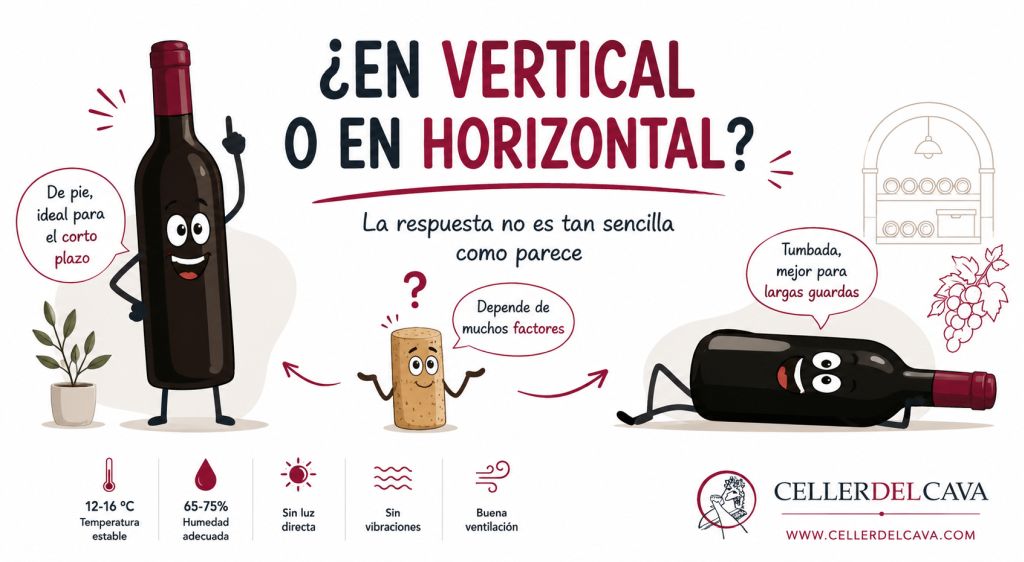
The answer isn't as simple as it might seem. For decades, the horizontal position has been considered the best option for preserving wines sealed with natural cork. However, various studies have shown that other factors, such as temperature, humidity, light, or vibrations, have a much greater impact on the wine's evolution.
Most wines with cork stoppers can be stored either lying down or upright for short periods. However, for long-term aging, the horizontal position remains the most widely used by wineries, collectors, and industry professionals.
How should a wine bottle be stored if it will be consumed within a few weeks?
If you've just bought a bottle and plan to open it in the coming days or weeks, the most advisable option is to keep it upright.
This position makes it easier for any sediment to settle at the bottom of the bottle and prevents unnecessary movement of the wine. It's also more convenient for temporary storage and poses no risk to its short-term preservation.
In the case of aged red wines or unfiltered wines, it's advisable to let them rest for a few days before opening so the sediment can settle completely.
What is the best position for storing wines over the years?
When it comes to wines intended for long-term aging, the horizontal position remains the most common.
Traditionally, it's been believed that keeping the wine in contact with the cork helps preserve the stopper's elasticity and ensures a proper seal. For this reason, most wineries and wine shops store their bottles lying down.
However, we now know that the most important factor for properly preserving a wine is not so much the bottle's position as the environmental conditions it's kept in.
For optimal preservation, it's recommended to maintain:
- A stable temperature between 12 and 16 °C.
- Relative humidity between 65% and 75%.
- Absence of vibrations.
- Darkness or very little light exposure.
- Good ventilation.
- Avoiding sudden temperature changes.
A bottle stored lying down in poor conditions will age worse than a bottle stored upright in a suitable environment.
What happens if I store wine upright for a long time?
Many people believe that a bottle stored upright for years will inevitably spoil. The reality is that this isn't always the case.
Various studies have cast doubt on the idea that the cork necessarily dries out when the bottle remains upright. The inside of a bottle maintains very high humidity, which helps preserve the stopper even without direct contact with the wine.
For this reason, more and more experts consider that the difference between storing a bottle upright or lying down is smaller than traditionally thought, as long as the storage conditions are adequate.
How should bottles of cava and other sparkling wines be stored?
Cava, champagne, and other quality sparkling wines deserve special mention.
For many years it was recommended to store them upright due to the bottle's internal pressure, which helps keep the cork expanded and perfectly sealed.
Today, many wineries continue this practice for long-term storage. In any case, for the individual consumer, maintaining a stable temperature and avoiding sudden changes remains far more important than the bottle's specific position.
What about wines with screw caps or technical closures?
Wines sealed with screw caps, synthetic stoppers, or glass closures don't present the drawbacks associated with natural cork.
In these cases, storage position has minimal importance, and bottles can be kept either upright or lying down depending on available space.
Common mistakes when storing wine at home
Although most enthusiasts worry about the bottle's position, there are far more harmful mistakes for wine preservation:
- Storing bottles near radiators or heat sources.
- Exposing them to direct sunlight.
- Keeping them in kitchens with large temperature swings.
- Moving them constantly.
- Storing them next to products with strong odors.
- Keeping them for years in garages or storage rooms without temperature control.
Avoiding these mistakes will have a much greater impact on wine quality than choosing between upright or horizontal storage.
In summary
If you're going to drink the wine within the next few months, you can store it perfectly well upright. For wines intended for long-term aging, the horizontal position remains the most widely used option, especially for bottles with natural cork stoppers.
However, the real key to properly preserving a bottle lies not so much in its orientation as in maintaining a stable temperature, adequate humidity, and protecting the wine from light and vibrations.
Article prepared by the Celler del Cava team, specialists in wine, cava, and spirits since 1985.
Comments (0)